Categorie archief: English Jam
Dale Stephens on Hacking your Education
Hi Judith,
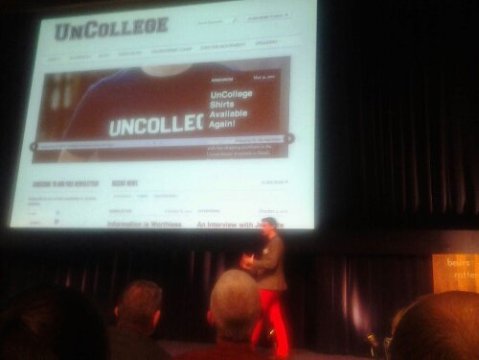
The last keynote today, from Dale whonis a 20ish entrepreneur who is going to tell us about that college isn’t preparing students for real life. He is the owner of UnCollege.org. Like dr. Chuck he is on a quest teying to create a teachers community but not specially to get a degree, more to find out what you want to do and learn in the process doing that.
Dale stopped going to school and did unschooling. This is not homeschooling, this is not sitting at home viewing online MIT lectures. Unschooling is going out meeting people and learning together. He did a lot of things: political campaigns, participating in startups, building a library and then some more experiences. As College/University was a goal, Dale was dissapointed by the system when he got there. Out of frustration a friend suggested to start his own College. After dropping out, he did, the UnCollege. The UnCollege should provide you with things that you know from College, it isn’t only colleges that have beer, girls or guys, champagne or knowledge.
Dale gives us insight in the college debts problems in the States, which is crawling upon The Netherlands as well. Studentdebt will not go away like mortgage debt if you go bancrupt.
Dale asks the question: Why can’t he go to Starbucks to learn. Dr. Chuck showed half an hour ago that he went to starbucks with his MOOC to teach! Dale meet Dr. Chuck! Is this a or the revolution? Or are Dale and Dr. Chuck inspiring speakers that live in the American dream, which perhaps is too far away for us Dutchies? I don’t know but please let me sleep and dream some more on it!
Being member of the community gets you as far or even further as College according to Dale. My question is: can’t we benefit from both worlds? Let’s at least try 😉
Are you joining me in our new institution, Oh no it isn’t an institution it will be a movement 😉 Judith?
Greetz Marcel Schmitz
P.S. Warning for Chris Kuijpers, you were right a couple of months ago. And I will pursue it!
18112012Judith: Blogs van Wilfred Rubens en Joel Bruijn & Video:
Dr. Chucks MOOC (third session at SURF onderwijsdagen 2012)
Hi Judith,
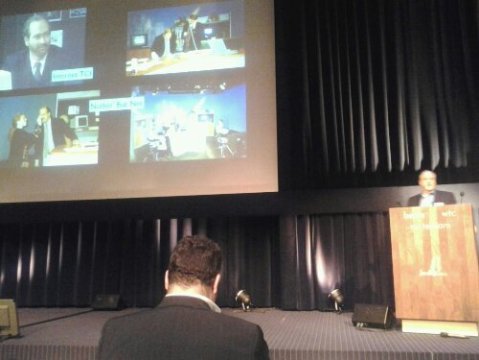
After my first encounter with dr. Chuck, Charles Severance at Educause 2010 in Anaheim, I just wanted to see him again. This time his talk was on Massive Open Online Courseware (MOOC) which is not new, but in hype mode right now.
- First plus of a MOOC in a weblecture you see more of dr. Chuck and dr. Chucks sheets than in a large collegeroom. He can send more pixels to our eyeballs on a MOOC than in a classroom.
- Second plus, 45000+ students participated in his MOOC, it takes a long time to teach that many ppl in an ordinary classroom.
- Third plus, dr. Chuck reached all ages and all degrees, there was a wide range in participants.
Dr. Chuck explains that your MOOC should deliver to the people that want to put in a lot of effort, but also the people that want to do the light version. He tried to do that within his MOOC. He wanted to make the environment open and let the users be teachers. So in forums he engaged to the students that were helping othera, in stead of helping them himself. That is creating a learning environment! Dr. Chuck owns the universe and used crowd sourcing for making better examples, better content, content in the context and language of the students. The calling to create the Teach the Teachers as we do in Zuyd gets an world level with a MOOC.
Dr. Chuck did some investigation on cheating on the final exam. Great graphs on the results ‘grin’, but he found out the messaging, mailing, chatroom cheating of the test. In this form there were only 20 of 5000 cheating.
Where is this goimg in the future?
Coursera is great at the moment, but at the moment you need someone that lets you teach on closed source tools like Coursera. Closed source means slow innovation. Open Educational Resources is a little bit out of sight and often in just one context.
Charles Severance still is on track with his Teach the Teachers community. His battle is against whomever is against The Teachers Community. Sakai, Blackboard, … you fill in the dots…. Let’s join his fight!
He let’s us see the EPUB 3.0 specs, which is within the core of the e-books for iBooks from Apple, but also usable in Readium, an open source reader. This will spread out as molecules. Dr. Chuck is checking out publishing tools for the EPUB 3.0 specs, perhaps he will make one 😉
Credits go to Stanford for the efforts and investments around MOOCs. Class2Go is the tool behind, open source and available.
Dr. Chuck thinks that in the future every faculty has two or three MOOCs, strategic ones, but not everything. Thinking has to be done on the what and the how.
Dr. Chuck uses Coursera for his class, let’s try it, Judith! Please? Let’s learn together.
Greetz Marcel
P.S. Thanks to Willem for letting me make the picture
[18112012Judith: Ook Wilfred Rubens heeft over deze presentatie geblogd en de presentatie is nog te bekijken!]
MACESS E-Learning
Hi Judith,
As you know I had the opportunity to speak to a group of MACESS students (Master Social Work) about Learning in the 21th Century. In two sessions I addressed the following issues. I hope that I have made the students curious enough to search for more. And I hope that they were able to build up an (online) community on their topic.
Greetz Marcel
Woensdag 18-1-2012
The world is enhanced (Ignite)
http://igniteshow.com/videos/flash-mob-gone-very-very-wrong
Technology is enhanced (2009 – SixthSense)
http://www.ted.com/talks/pranav_mistry_the_thrilling_potential_of_sixthsense_technology.html
Enhanced Learning brings change in education and change in learning
– Ken Robertson Changing Education Paradigm http://www.youtube.com/watch?v=zDZFcDGpL4U
We discussed these movies and the implications on the social work field, on learning within the social work field and learning in general.
Donderdag 19-1-2012
Little children and technology
– http://www.youtube.com/watch?v=aXV-yaFmQNk
Learning is being enhanced. Where to go to keep up? Technology Enhanced Learning. Educause
http://www.youtube.com/watch?v=DHUufQm_gdA
http://wp.nmc.org/horizon2011/
– One Year or Less: Electronic Books (3) http://youtu.be/LV-RvzXGH2Y
– One Year or Less: Mobiles (0)
– Two to Three Years: Augmented Reality (0) http://youtu.be/Mk1xjbA-ISE
– Two to Three Years: Game-Based Learning (1)
– Four to Five Years: Gesture-Based Computing (0)
– Four to Five Years: Learning Analytics (0)
Tool: How to implement enhancement in your teams (TPACK)
TPACK Discuss filmpje http://youtu.be/I2sD3K3daq8
Kennis is macht, delen is machtiger, co-creatie is de kracht (zie ook: https://2bejammed.org/2010/05/16/broeden/) boek We Think / Charles Leadbeater http://youtu.be/qiP79vYsfbo
What will the future bring us? Discussion
– Step from information to knowledge now is being made. Difference between Information and Knowledge
– Not only connecting the information, but also connecting the context, the association and delivering in your knowledge intensified way (personalised)
Serious Gaming
http://www.youtube.com/watch?v=dE1DuBesGYM
http://www.youtube.com/watch?v=ZztLac0Q1EI
– Made each other a little bit more Curious: https://2bejammed.org/2012/01/12/watch-this-video/
Films not watched during class:
– Tom Suarez http://www.youtube.com/watch?v=na7-Bnb_Ot8
– Social Media in Education http://www.youtube.com/watch?v=3zKdPOHhNfY
Rethinking education http://youtu.be/5Xb5spS8pmE van Educause
of Social Learning http://youtu.be/B4MYa-cWJA8
-Open and Multiuser http://www.slideshare.net/michaelkowalczyk/learning-in-times-of-abundance-the-snowflake-effect-1886416 (slideshare English)
First playtest #Somega has started
Hi Judith,
As you have noticed. We have recently started play testing the Social Media Game: SΩ (pronounced: somega). Last friday students of the Minor Digicoach presented by my colleague Ankie van den Broek have engaged in this new game that we (yes including you) are developing together. The purpose of the game is getting a lot of xp in the field of social media by using the tools available. Students are challenged to use the media on the topic: ‘digital coach’.
I am, as the students, very excited on this for us new way of learning. I hope that I can maintain the level of enthousiasm the students showed after the first meeting. The next 10 weeks will answer that for us.
Students get the opportunity to play with three types of quests. The first two types I have introduced friday. It are ‘normal’ missions which are open and for everyone to know. In the first mission (Cards below but written in Dutch) students have to get accounts in several social media. As you have seen I managed to create a logo: SΩ (somega – social media game) corny huh. Ankie (the teacher from the School of Education) called it: A high level of Big Bang terminology. Other ‘normal’ missions will be get peers to connect, or get experts on your field to connect. And those kind of missions. 
The real fun (I think) will be in the secret missions. You understand I cannot really go into the content of those missions as the students just have received their first secret missions. But for example (this one is not used -yet ;)-) a secret mission could be: Get the most retweets in the next two weeks. You’ll understand we have made them more spicy than that. At least some of them 😉
The third kind of missions are achievements. For instance the first one that reaches a set amount of followers will receive a price for achieving that level of followers.
In the first weekend 3 of the 5 participating students have been very active and 2 have already posted their first blog post. I hope we (the gamemaster, Ankie, you (?) and me) can buff their energy, experience en commitment to the project.
It was a good start. Now we have to see how the next weeks will go. I will keep you posted on this topic.
Our colleague Frans has interviewed me on this topic (in Dutch) http://weblectures.blogspot.com/2011/11/social-media-game-als-onderdeel-minor.html
Game On!
Greetz Marcel





 2 BE JAMMED