Positive Platforms
Beste Judith, Barbara, Dominique en Marije,
Met ieder van jullie ben ik min of meer bezig geweest met communities of netwerken die samen gaan werken of samen kennis, ervaringen of producten gaan delen. Ik weet dat we allemaal op zoek zijn naar de goede weg om dit te realiseren en ik weet ook dat we allemaal worstelen terwijl we op weg zijn.
We zijn niet de enige die dromen en bouwen aan platforms die het positieve moeten delen. The institute of the Future heeft eind vorig jaar met veel mensen gebrainstormd. Bekijk onderstaande impressie, wellicht kunnen we er van leren.
Ik heb het er graag met jullie over.
Groet Marcel
Ontwerp je eigen blend
Ha Judith,
Je hebt uitgebreid geblogged over de SURF onderwijsdagen 2016 (hier, en daar, en ook hier). Wellicht moet je me even helpen en staat het er toch, maar ik kwam via de SURFSPACE een artikel tegen over het ontwerpen van je eigen blend. En ik moet zeggen de manier van presenteren met icoontjes, de link naar de hele set van materiaal (ik weet niet of die buiten SURF te lezen is en of die gedeeld mag worden) geeft een boel materiaal om mee te werken.
De presentatie staat hieronder en ik hoop niet dat ik hem in ons collectieve bloggeheugen gemist heb. Als dat toch zo is, hij is volgens mij het herhalen waard.
Het lijkt me goed als we op deze manier, met icoontjes ook de leeractiviteiten van Zuyd in kaart brengen. Ik ga dat in ieder geval al eens doen voor de faculteit ICT.
Groet Marcel
VirtualiTee
Hi M!
Ik zag vandaag toch zo iets leuks via Twitter voorbij komen. Als ik het eerder had gezien, was het een leuk verjaardagskadootje voor youknowwho geweest :).
Een Augumented Reality T-shirt, de Curiscope’s VirtualiTee.
It’s tee-rrific! zoals ze zelf in hun kick-startersfilmje zeggen.
Fijn weekend verder
Judith
Laatste nog te beoordelen huiswerk: Learning analytics for learning design, an opportunity for better learning.
Ha Judith,
Om je deelgenoot te maken van het laatste nog te beoordelen huiswerk van de laatste van vier online cursussen die ik nodig heb voordat ik aan mijn eindwerk mag beginnen, post ik bij deze mijn bijdrage. Het gaat over learning analytics for learning design kortom een onderwerp dat zeker past op dit blog.
Enjoy!
Groet Marcel
Learning analytics for learning design, an opportunity for better learning.
Despite the great success surrounding learning analytics and the increasing amount of available learning analytic tools, most educational organizations, are only aware of the potential of learning analytics regarding personalized learning and have limited experience with its application (Bichsel). All educational organizations use some form of learning design to organize their education. Analyzing the behavior and actions of students with regard to the learning design enables institutions to adapt for better learning. In order to shift the educational sector towards a more data-driven educational science, it is necessary to gain more insights in the effects of applying learning analytics in learning design.
First to illustrate, learning analytics is the field of learners data, which can be automatically harvested and analysis of these data has the potential to provide evidence-based insights into learner abilities and patterns of behavior, cognition, motivation, and emotions. The use of learning analytics to inform decision-making in education is not new, but the scope and scale of its potential has increased enormously with the rapid adoption of technology over the last few years (Siemens). At the data side, the rise of Big Data leads, in addition, to rapid development of useful techniques and tools to analyze large amounts of data. Better analysis on bigger amounts of data can be made within educational institutions by combining information across faculties. At the visualization side, better and more informative dashboards have come commercial available for institutions to use to get more insights in the actions and behaviors of students. These insights in turn can provide a crucial guidance for a more personalized curriculum design and can help teachers with the design of their education.
Secondly, illustrating Learning design as the combination of the learning activities and the support activities that are performed by different persons (students, teachers) in the context of a unit of learning e.g. a module or course. Donald et al. stated that “A learning design (product) documents and describes a learning activity in such a way that other teachers can understand it and use it in their own context. Typically a learning design includes descriptions of learning tasks, resources and supports provided by the teacher. learning design is also the process by which teachers design for learning, when they devise a plan, design or structure for a learning activity” (179). In further detail, developing a learning design a teacher or educational designer works on all phases of an instruction; starting from the definition of prior knowledge prerequisites of the target student group, design of learning objectives and outcomes, and design of the assessment to test if the outcomes have been achieved. In between are many choices for appropriate learning activities and sequences, content, teaching methods, materials and other resources that contribute to achieving the learning objectives. Efforts to incorporate personalized learning into learning designs are sought, because personalized learning is a potential approach to meeting future educational needs. Little educational concepts embed tools into their learning design to optimize personalized learning. Thus, little knowledge considering the actual use of learning analytics in educational practice and its contribution for educational theories is available (Wise). A lot of opportunities are available to improve the usage of learning design.
After illustrating learning analytics and learning design, the potential of the combination of them both, to improve education to a more personal level can be shown. The teaching activities and resources evolving from the learning design are provided increasingly over IT infrastructures and are most of the time also digitally available. This offers opportunities to use learning analytics as part of the learning environment and the learning design (Lockyer). It is of crucial importance for a learning analytics-supported learning design to consider potential learning analytics indicators already while designing the learning objectives and various activities (Lockyer). Like assessment procedures, learning analytics indicators should be considered in the very beginning of the development of the learning design. In that way, e.g. a ‘forum discussion’ is not only an effective learning activity on itself, but learning analytics can also provide an much more efficient and effective overview of e.g. student participation that could provide both student with self-monitoring information and make teachers more aware of the learning process of his students and adds possibilities for personalized feedback. However, a clear and user-friendly presentation of the learning analytics information is essential for the effect of it. learning dashboards are used to visually present learning performances. A dashboard can be defined as a visual display of the most important information needed to achieve one or more objectives; consolidated and arranged on a single screen so the information can be monitored at a glance (Few). A learning dashboard can provide both teachers and students with insights in study progress and potential for improvement.
In order to apply learning analytics in learning design, learning designers must gain awareness and knowledge about the potentials and limitations of learning analytics. A comprehensive introduction to different domains that are affected by learning analytics was provided by Greller and Drachsler. They developed a generic design framework that can serve as a guide in developing Learning application in support of educational practice. The framework addresses six fields of attention that have to be addressed in every Learning analytics design: 1. Stakeholders, 2. Objectives, 3. Data, 4. Instruments, 5. External constraints, 6. Internal limitations (42). The stakeholders are the students, teachers, institutions, but also the service providers. The objectives of using analytics can be to reflect current behavior, but also to predict if for instance students potentially drop out. How open the data is that can be used and how the data that is used can be protected are part of the data field. The instruments to gather data, analyze it and intelligently perform computations upon are the fourth field. External constraints are privacy and ethics issues. And last field, the internal limitations consider the competences users bring to use learning analytics.
Besides technical implementation, the competences of users of learning analytics for learning design have to be considered in developing a solution. There are the two crucial aspects of ’awareness’ and ’reflection’ that need to be taken into account when dealing with learning analytics for learning design. The reflection on presented analytics results is not possible without awareness which in turn depends on some form of feedback to the user. According to Endsley being aware of one’s own situation is a three level process and a prerequisite for making decisions and effectively performing tasks: the perception of elements in the current situation is followed by the comprehension of the current situation which then leads to the projection of a future status (32). Reflection can promote insight about something that previously went unnoticed and lead to a change in learning or teaching behavior. Verbert et al. emphasize the importance of these aspects in their four-stage process model for learning analytics applications: awareness, reflection, sense making, and impact (1500). Technology, thus, is not the only aspect of implementing a learning analytics for learning design solution, the competences of the users is an equally important aspect.
In conclusion, more applications of learning analytics in learning design are an opportunity to increase learning experiences for students. This development is both an effort on implementing the currently available data analytics technology in an educational context, and an effort to invest in supporting competences of the users of learning analytics for learning design applications. Succeeded in these challenges will deliver a more personalized learning environment and thereby better learning efficiency and satisfaction for students.
Works Cited
Bichsel, J. “Analytics in Higher Education: Benefits, Barriers, Progress, and Recommendations.” EDUCAUSE: Center for Applied Research, 2012, pp. 1–31.
Donald, C., Blake, A., Girault, I., Datt, A., & Ramsay, E. “Approaches to Learning Design:
past the head and the hands to the HEART of the matter.” Distance Education, 2009, vol. 30 no. 2, pp. 179–199.
Endsley, M.R. “Toward a Theory of Situation Awareness in Dynamic Systems.” Human
Factors, 1995, no. 37, pp. 32–64.
Few, S. “Information Dashboard Design.” The Effective Visual Communication of Data Sebastopol, 2006, no. 1, pp. 223.
Greller, W., Drachsler, H. “Translating learning into numbers: A generic Framework for
Learning Analytics.” Educational Technology & Society, 2012, vol. 3, no. 37, pp. 42–57.
Siemens, G. “Learning Analytics: The emergence of a Discipline.” American Behavioral
Scientist, 2013, vol. 10, no. 57, pp. 1380 – 1400.
Verbert, K., Duval, E., Klerkx, J., Govaerts, S., Santos, J. “Learning Analytics Dashboard
Applications.” American Behavioral Scientist, 2013, vol 10. no. 57, pp. 1500–1509.
Wise, A., Shaffer, D. “Why Theory matters more than ever in the age of Big Data.” Journal
of Learning Analytics, 2015, vol. 2, no. 2, pp. 5–13.
Horizon Report 2017
Hi Marcel,
En hier is de definitieve versie dan: Horizon Report 2017 Higher Education Edition!
Natuurlijk is er inhoudelijk niets veranderd tov hetgeen ik blogde over de preview van deze editie. Het is een uitgebreider jasje gestoken. En de Key Trends, Significant Chanllenges en Import Devolopments in Technology staan nu in een mooi overzichtelijk schema. 78 Experts van NMC en Educause hebben onderstaande uitdagingen, belangrijkste trends en ontwikkelingen op het gebied van onderwijs en technologie voor een periode van nu tot 5 jaar in kaart gebracht.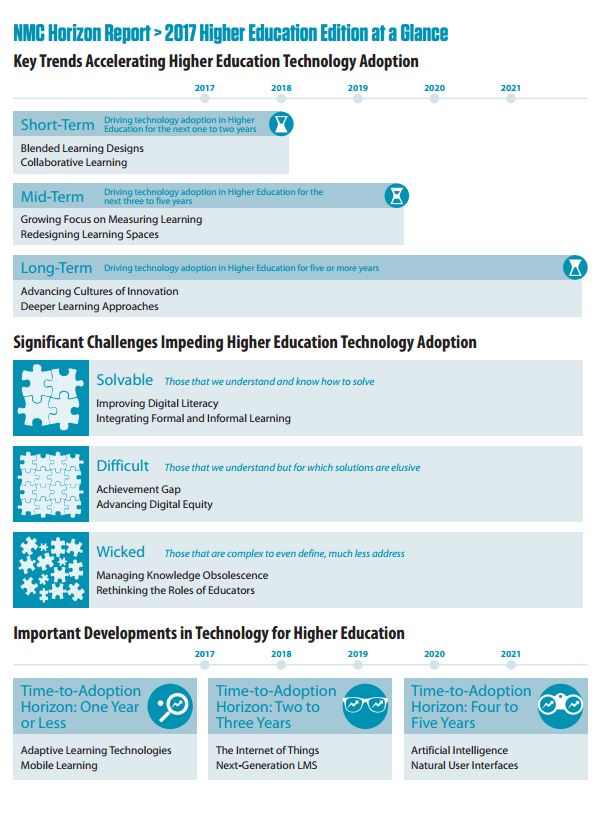 De basis van bovenstaande 18 topics zijn volgens de expert in 10 thema’s van onderwijskundige veranderingen te vatten:
- Advancing progressive learning approaches requires cultural transformation
- Real-world skills are needed to bolster employability and workplace development.
- Collaboration is key for scaling effective solutions
- Despite the proliferation of technology and online learning materials, access is still unequal
- Processes for assessing nuanced skills at a personal level are needed
- Fluency in the digital realm is more than just understanding how to use technology
- Online, mobile, and blended learning are foregone conclusions
- Learning ecosystems must be agile enough to support the practices of the future
- Higher education is an incubator for developing more intuitive computers
- Lifelong learning is the lifeblood of higher education
Als je geen tijd hebt om het hele rapport te lezen dan kan je ook even 7 minuten de tijd nemen om deze video te bekijken
Vorig jaar benoemde ik de steeds groeiende kritiek op dit rapport omdat er weinig wordt gereflecteerd op eerdere voorspellingen en trends. Dat hebben zich blijkbaar in hun oren geknopt. Dit jaar wordt ook teruggekeken:
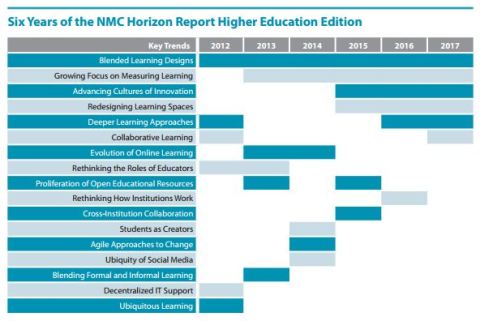

Al deze topic kunnen volgens het rapport in 6 overkoepelende thema’s worden gevangen:
- Expanding access and convenience
- Spurring innovation
- Fostering authentic learning
- Tracking and valuating evidence
- Improving the teaching profession
- Spreading digital fluency
Het is duidelijk dat het tijds-en plaatsonafhankelijk leren en werken, het ruimte bieden aan innovaties, actief leren, het data-driven onderwijs en alle technologische mogelijkheden eisen stelt aan de digitale en pedagogische competenties van docenten, maar ook aan de digitale vaardigheden van studenten.
Nog werk genoeg, zou ik zo denken.
Judith





 2 BE JAMMED