Categorie archief: English Jam
Let’s play in our Minor Web and Beyond!
Hi Judith,
How are you doing? Still going steady or are you getting beyond? Well I am currently very excited about a Minor (Course, 10 full time weeks) that is developed at the Hotelschool Maastricht. Our colleague Jos Maas is the inspiration point for this Minor and he has organized several sessions with educators, innovators, experts in the field of hospitality and new media and new technology users to create a Minor were the borders of the Hospitality and Technology worlds are being crossed.
We are trying to add some innovation skills to the students that are participating within the Minor. But the Minor itself will be a first for me too. We are trying to get a gamebased approach. Jos Maas (Hotelschool Maastricht), Miguel van der Laar (Software Engineering Heerlen), Erik van der Dussen (Entrepeneur in a 2.0. world and former Hotelschool Student) en myself (iTeam) are building this minor and we are trying tot make a game of it. Check my Prezi to get an idea:
.prezi-player { width: 550px; } .prezi-player-links { text-align: center; }http://prezi.com/bin/preziloader.swf
We already made a visualisation of a board, but this is still pretty much under construction.
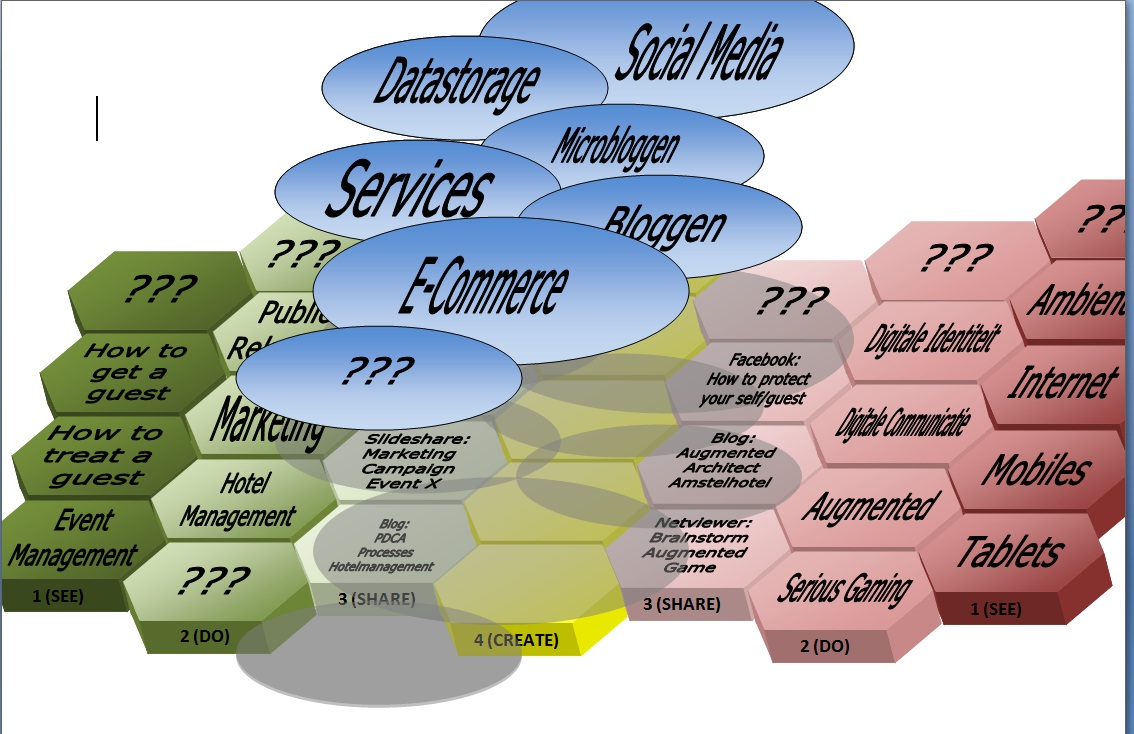
I will explain the rules later when I have finished the rulebook. But what you see is the two worlds (Red and Green) of Hospitality and Technology. The participants of the minor will be Hospitality students (they’ll start on the technology side) and Software Engineering students (they’ll start on the hospitality side). The players are part of a multifunctional group (2 Software Engineering students combined with 2 Hospitality students). But the members of the group are placed on either sides of the board. They have to move towards the middle, where the group will ben together and try to bridge the borders of their own field of expertise and the field of the group members. This all under the Web 2.0/Social Media/Innovation Cloud which influences the directions the innovation is going.
At the moment we are developing several things, which can be categorized in two major parts: 1) Bringing the fun to the game (You should think of: Extra levels, unlocking specials, Bringing prices to the board) 2) Bringing the serious to the game (And what I mean by that is that this game and it’s challenges is played in an university of applied sciences. Students get grades for the minor and these are parts of their certificates en diplomas. So their should be a link between the challenges and the basics of the two different educationals basics from both studies.) Fortunatly both studies work with competences and prestation indicators, which can be translated into quests/challenges.
As students are free to choose their minors, I hope that people will like this one which prepares them to be innovative in a changing world. It lets them learn the game of Innovation. Which as you know can be a real frustration and fun like the boardgame Ludo, which in dutch is called something like: Don’t get annoyed!
 The boardgame LUDO which is called: “Mens erger je niet” in the Netherlands (translated: Don’t get annoyed!) The boardgame LUDO which is called: “Mens erger je niet” in the Netherlands (translated: Don’t get annoyed!) |
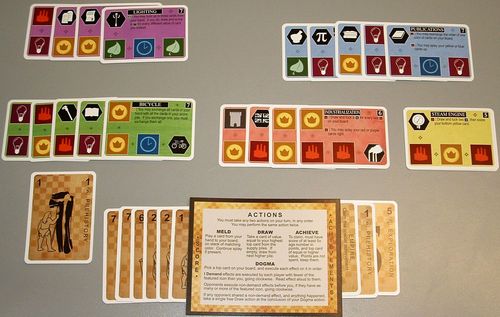
The cardgame Innovation. |
I am looking forward to play a round of … and Beyond in the Hospitaly, Web and Beyond. If sufficient students apply we will get to play a round in februari.
I will keep you informed on this topic.
With kind regards,
Marcel Schmitz
Code of Conduct for SM?
Hi Judith,
Welcome to the first English version of our duoblog. I know that you won’t react in English (yet!) but still I want to try to give our English speaking friends some insight in the way we at Zuyd University are using technology enhanced learning. So sometimes you will find a summary of our past Dutch blogitems in this category and sometimes you will find a story of it’s own. This time I have chosen the later.
You remembered our last session at Educause 2010? It was about Social Media (yeah that’s where SM stands for ;)) with Tanja Joosten @tjoosten of the University of Wisconsin and her friend Shannon Ritter @micala of State College PA as our hosts. They were promoting #edusocmedia and discussing all kind of social media in education topics. I am very happy to say that we can send some colleagues to educause 2011 :), but that means that we have to stay at home 😦
That doesn’t mean that we can’t interact with the conference. Shannon has dropped the question on twitter on which topics should be discussed at the conference and that made me thinking (well that and off course the urge to blog something in English and this was a great opportunity 😉 ) 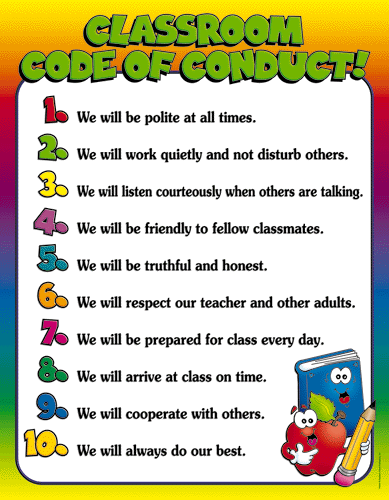 One of the rising topics within our education environment on social media is if there should be a code of conduct for teachers on how to use social media as communication device, especially with regard to communicating to students. I know that our friend Ankie van den Broek @ankievandenbroe is preparing/discussing on a code of conduct for her colleagues of ‘the school for teachers of elementary en middle schools’ (called: PABO in Dutch.) What do you think? Should there be such a code, probably even University wide, which oblige our colleagues to contact students with social media in certain ways?
I agree on training how to use social media (which is very much needed), I agree on raising awareness of using social media, University wide (both teachers and students), but I am against a code of conduct. Social Media should be used free of rules as freedom of speech is used. The second part of that sentence is, for me, very important. Freedom of speech can also be abused and that’s not the intention of it. You should always be aware what you say! And you should try to be aware of the impact that has one the ones that can hear/read your message. (Un)fortunately with Social Media that are potentially a lot of people! This awareness should be in the standard package of our colleagues. But is it? And how about the students? And what about the children of elementary and middle schools, for whom we are training the teachers? Should there be a code of conduct? History has proven that neither adults or children always are able to use the ‘freedom op speech’ the way it was intended. And whom I am to say how it was intended?
 Well I have another argument against a code of conduct. And that’s the impossibility to preserve the code when it is in effect. How do we monitor total online behavior, and how do we react on misbehavior. The simplest way seems to be reacting on the person that doesn’t act along the code, but this person has always the possibility to change his/her online identity and continue his/her bad behavior.
The only way seems to me are the three A’s: Awareness, Acceptance, (and again) Awareness.
- Teachers and Students should be made aware of the fact that Social Media can’t be controlled and that the only rule that really matters is the rule of ‘freedom of speech’ and that that rule comes with a responsibility.
- Teachers, Students and Management should accept that in this open and online world Social Media will be used and that it is not to be controlled by rules.
- Teachers and Students should be made aware of the worldwide, everlasting impact speaking through Social Media has and which implications that has on using the implications of ‘freedom of speech’ has.
Accept and be aware that technology has made our voices a powerful tool that can reach the world and beyond. Anything you say will be heard and will be used!
Greetz Marcel





 2 BE JAMMED